Most conversations about engineering culture start in the wrong place. They start with a tool, a reorganisation, or a framework somebody read about. They rarely start with a clear picture of what a healthy engineering organisation actually looks like, across all the dimensions that matter, simultaneously.
That is why I came up with The Engineering Culture Model. It maps those dimensions, eight in total, arranged as a compass, each one connected to the others. The model grew out of years of transformation work: patterns seen across organisations that struggled, and patterns seen in the ones that didn’t. It is not a maturity model with stages to climb. It is a diagnostic, a way to see where an organisation is strong and where it is quietly breaking down.
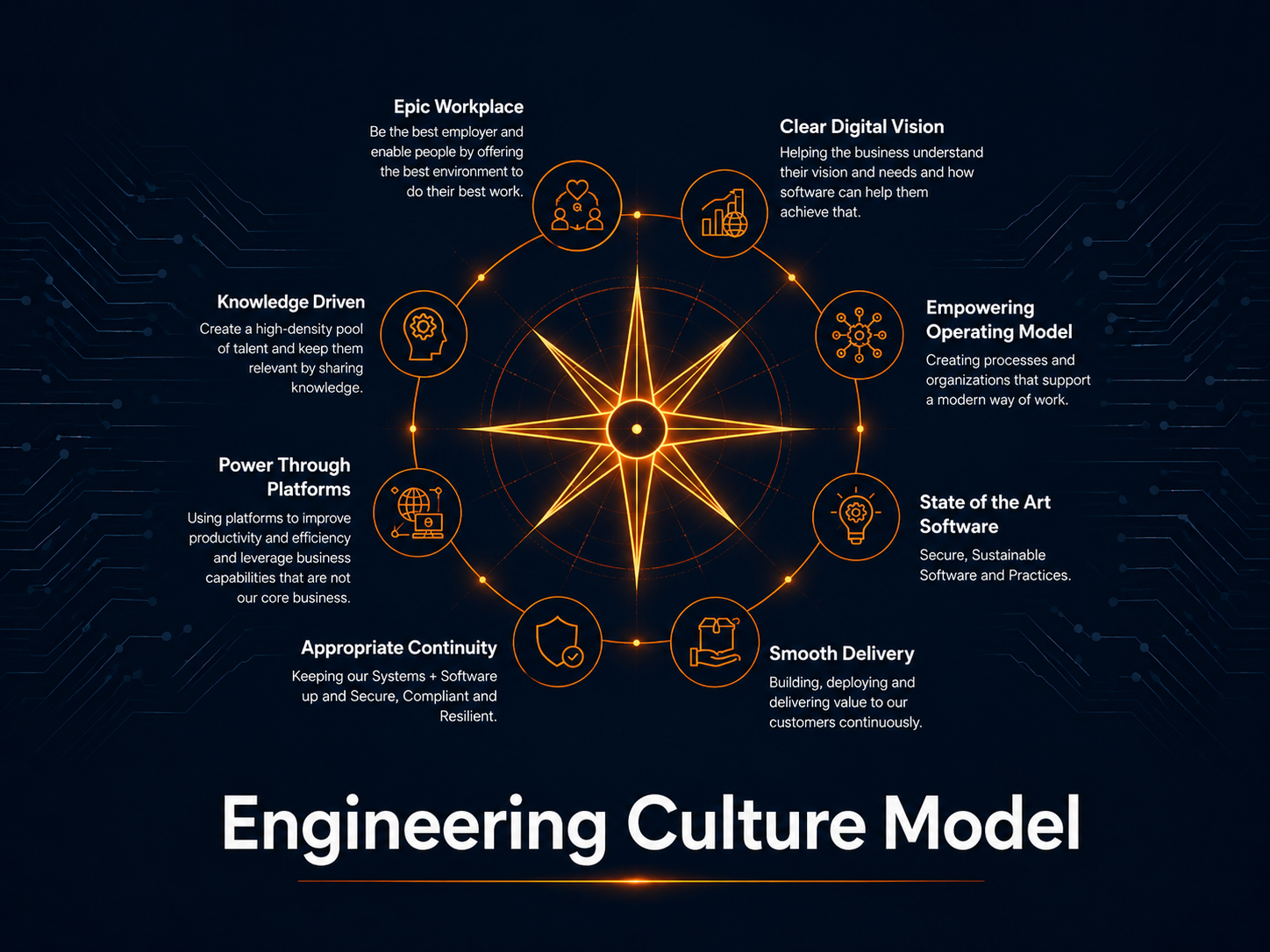
The eight dimensions
| Dimension | What it addresses |
|---|---|
| Clear Digital Vision | Does the business understand its own technology needs — and does technology understand the business well enough to help it get there? |
| Empowering Operating Model | Are the structures, processes, and ways of organising work designed to support the speed and autonomy that modern software development requires? |
| State of the Art Software | Are the practices, quality standards, and technical foundations secure, sustainable, and built for the long term? |
| Smooth Delivery | Can the organisation build, deploy, and get value to customers continuously — or are releases still events rather than routines? |
| Appropriate Continuity | Are the systems and software compliant, resilient, and maintained with the seriousness that operational risk deserves? |
| Power Through Platforms | Are platforms being used to reduce undifferentiated work and let teams focus on what actually matters to the business? |
| Knowledge Driven | Is talent being developed, kept relevant, and connected — and is knowledge treated as a shared asset rather than a personal one? |
| Epic Workplace | Is this an environment where good people genuinely want to work, and where the conditions exist for them to do their best work? |
How I use it
I use this model as a diagnostic before any transformation conversation. In most organisations, two or three dimensions absorb all the attention, usually Smooth Delivery and State of the Art Software, while the others are left to drift. That imbalance is almost always behind the stalling, the attrition, and the missed delivery promises.
The model forces a wider view. Plotting an honest assessment across all eight dimensions makes the gaps visible and gives leadership a shared language to discuss what needs investment, and in what sequence.
Common mistakes
Fixing the visible dimension, ignoring the adjacent ones — Delivery problems are routinely treated as a tooling or pipeline problem. But if Knowledge Driven is weak, teams cannot share what works. If the operating model is broken, teams are blocked by approval chains no tool can fix. Each dimension creates the conditions for the others to function.
Treating it as a checklist — The model is not a certification. Ticking off all eight means nothing if they are not reinforcing each other. The goal is coherence, not coverage.
Starting with technology — Clear Digital Vision and Empowering Operating Model need to come first. Investing in software quality or delivery speed before the vision and operating model are right is building on sand.